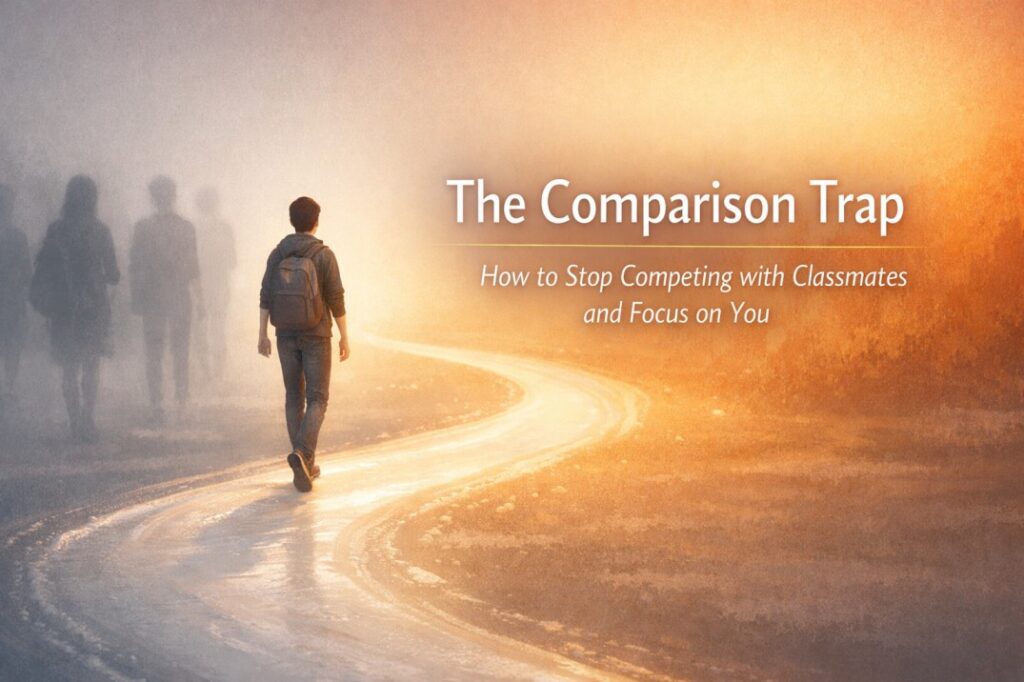
The comparison trap often begins quietly, right inside classrooms, result sheets, and casual conversations that sound harmless but slowly unsettle the mind. You notice a classmate scoring higher, progressing faster, or appearing more confident, and suddenly your own effort feels smaller.
This mental shift creates confusion, hesitation, and self doubt, even when you work sincerely and stay consistent. Understanding this pattern is the first step toward reclaiming focus, clarity, and confidence that belong to you alone.
In this Guide:
Understanding the Comparison Trap in Student Life
The comparison trap is not a weakness or a flaw in character, it is a learned response shaped by surroundings and expectations. From early education, students absorb signals that performance defines worth, often without anyone stating it openly.
As a result, the mind starts scanning classmates for reference points instead of staying anchored in personal growth. Over time, this habit replaces curiosity with pressure and learning with silent competition.
Students rarely realize when comparison becomes automatic. It feels logical, responsible, and even motivating at first. However, beneath that surface, it quietly erodes self trust and emotional stability.
Why Comparing with Classmates Feels Automatic
The human brain naturally looks for patterns and benchmarks, especially in structured environments like schools and colleges. Grades, ranks, and public recognition give the mind easy metrics to measure value.
When these markers appear repeatedly, comparison feels like a survival skill rather than a choice. This explains why even confident students slip into self judgment after seeing others perform differently.
How Academic Environments Fuel Silent Competition
Academic systems reward visible outcomes more than invisible effort. As a result, students rarely discuss struggles, doubts, or learning curves openly.
This silence creates an illusion that everyone else feels confident and ahead. The gap between reality and perception keeps the comparison cycle active and emotionally draining.
The Hidden Emotional Cost of Constant Comparison
Constant comparison does not push students forward, it quietly pulls them inward. Energy that should support focus and learning gets redirected toward worry and self evaluation.
Over time, this shift affects motivation, mood, and emotional balance. Students often feel tired without understanding why. The emotional cost builds slowly, which makes it harder to recognize. By the time frustration surfaces, the habit already feels deeply ingrained.
Loss of Focus and Inner Motivation
When attention stays fixed on others, concentration weakens. Study sessions feel longer, distractions increase, and effort starts feeling heavier than before.
Motivation fades because progress no longer feels personal or meaningful. This loss does not reflect capability, it reflects misplaced focus.
Anxiety, Self Doubt, and Burnout Patterns
Comparison keeps the nervous system alert, even during rest. Students begin associating peers with threat rather than inspiration.
Anxiety increases around exams, discussions, and results. Eventually, emotional exhaustion appears, often mistaken for laziness or lack of discipline.
Why Someone Else’s Progress Is Not Your Benchmark
Every student walks a different path shaped by background, timing, and inner readiness. Comparing progress ignores these variables and creates unfair conclusions.
What looks like fast success often hides support systems, prior exposure, or personal circumstances. Recognizing this truth helps soften self judgment without reducing ambition.
Progress becomes meaningful only when measured against personal effort and understanding.
Different Starting Points, Different Strengths
Some students begin with academic confidence, others build it gradually. Resources, learning styles, emotional stability, and past experiences influence outcomes deeply.
Effort looks similar on the surface, but internal conditions vary widely. Acknowledging this difference restores fairness in self evaluation.
The Myth of Equal Timelines in Education
Education promotes shared timelines, but growth rarely follows uniform speed. Some learners bloom early, others steadily, and many quietly later.
Delayed progress does not signal failure, it signals preparation. Trusting this rhythm reduces urgency and preserves confidence.
Shifting from Competition to Self Focus
Moving away from comparison does not mean abandoning goals. It means redirecting attention toward effort, learning quality, and personal improvement.
Self focus allows ambition to exist without anxiety. This shift brings calm clarity that strengthens performance naturally. Students who adopt this mindset feel more present and emotionally grounded.
Redefining Success on Personal Terms
Success does not always appear as ranks or applause. It often shows up as consistency, deeper understanding, or improved self control.
When students define success internally, pressure loosens its grip. Meaning replaces noise, and motivation feels authentic again.
Measuring Progress Without External Validation
Tracking progress privately builds self trust. Noticing improved focus, better recall, or steadier routines creates internal reassurance.
This form of measurement sustains effort even during quiet phases. Over time, confidence stabilizes without external approval.
Building Student Self Confidence Without Comparison
Confidence grows when students feel safe within their own process. Removing comparison allows strengths to surface without fear.
Self belief becomes rooted in effort rather than outcome. This foundation lasts longer than praise or ranking. Confidence built this way remains steady during challenges.
Daily Habits That Strengthen Internal Stability
Simple routines support emotional balance. Reflecting briefly on daily progress reinforces awareness. Limiting result based conversations protects mental space. Consistency in these habits gradually rewires self perception.
Replacing Jealousy with Self Awareness
Jealousy often points toward unmet desires or ignored strengths. Observing it without judgment transforms it into information.
This awareness reduces emotional charge and increases clarity. Students learn more about themselves through reflection than reaction.
Academic Pressure Mindset: Compete Less, Learn Better
Learning thrives in calm conditions. Pressure narrows attention and reduces comprehension. When competition loosens, curiosity returns.
Students engage more deeply with subjects instead of racing through them. This mindset improves retention and emotional wellbeing together.
How Comparison Weakens Learning Quality
Stress shifts the brain into survival mode. Memory formation weakens under constant evaluation. Understanding becomes shallow and rushed. Removing comparison restores mental space for genuine learning.
Creating a Healthier Relationship with Performance
Performance improves when effort feels purposeful. Students begin valuing understanding over appearance. Mistakes feel informative rather than threatening. This relationship supports steady improvement over time.
Read more on Healthify Happiness:
- Manifestation Mistakes: Why Your Affirmations Aren’t Working (And How to Fix It)
- Stop Overthinking: 7 Emotional Tools to Quiet Your Mind Instantly
- Leadership & Empathy: How Emotional Intelligence Transforms Toxic Workplaces
- Post-Partum Wellness: prioritizing Your Mental Health After Motherhood
- Overwhelmed by Syllabus? How to Break Down Tasks and Stay Motivated
Success Story: Overcoming the Comparison Trap
Riya, a second year college student from Pune, constantly compared herself with classmates who spoke confidently and scored higher. Despite studying regularly, she felt invisible and behind. This emotional weight affected her focus and sleep.
Once she shifted attention toward personal goals and learning quality, her mindset changed. She tracked progress privately and reduced result based conversations. Within months, her confidence improved, participation increased, and anxiety reduced noticeably. Her performance stabilized because her energy returned to herself.
How Dr. Kaveri Bhatt Helps Students Break the Comparison Trap
Dr. Kaveri Bhatt works with students who feel stuck in cycles of comparison, pressure, and self doubt. Her approach combines techno spiritual healing with practical emotional tools that address subconscious patterns.
Instead of forcing mindset shifts, she helps release internal stress responses that drive competitive anxiety. Through trauma informed methods, students learn to regulate emotions and reconnect with self trust.
Subconscious release techniques reduce fear of judgment and performance pressure. Her work supports clarity, emotional resilience, and grounded confidence that aligns with personal growth rather than external validation.
What Real Students Say
Ankit, Delhi: “Letting go of comparison helped me enjoy studying again. I stopped measuring myself daily and noticed better focus within weeks.”
Megha, Indore: “I realized my pace was different, not wrong. That understanding reduced anxiety and helped me stay consistent.”
Rohan, Bengaluru: “When I focused on learning instead of ranks, my confidence improved naturally and my results followed later.”
Forum Discussions Around Classmate Comparison
Q: Is comparison ever useful in studies?
Some students feel comparison motivates them. However, long term reliance often increases anxiety and reduces self trust. Self focus works better consistently.
Q: How do I stop comparing when results are announced publicly?
Acknowledging emotions without reacting helps. Redirecting attention toward effort and improvement keeps comparison from settling deeply.
Practical Ways to Stop Comparing Yourself Daily
Awareness creates choice. Recognizing triggers allows conscious response. Small daily actions reduce comparison gradually. Consistency matters more than intensity here. Progress begins with gentler self dialogue.
Mental Resets for Trigger Moments
Pause and breathe when comparison arises. Name the emotion without judgment. Shift attention toward immediate effort or task. This reset calms the nervous system quickly.
Long Term Practices for Self Focused Growth
Journaling personal wins builds awareness. Reducing social comparison inputs preserves clarity. Setting process based goals strengthens commitment. Patience allows habits to take root naturally.
Frequently Asked Questions
Why does the comparison trap return even after awareness?
Habits formed over years take time to change. Awareness weakens the pattern, while consistent self focus helps replace it gradually and sustainably.
How long does it take to stop comparing completely?
Comparison reduces slowly rather than disappearing suddenly. With daily practice, emotional intensity drops within weeks, and clarity improves steadily.
Can ambition exist without competition?
Yes, ambition rooted in purpose feels calmer and more focused. It supports growth without creating constant anxiety or emotional strain.
What if classmates compare themselves with me?
You cannot control others, but you can protect your mental space. Maintaining boundaries keeps comparison from affecting your focus.
Does self focus reduce performance?
No, self focus improves learning quality and emotional stability, which often leads to stronger and more consistent performance over time.
Closing Perspective: Choosing Your Own Pace with Confidence
The comparison trap loses power when you stop using others as mirrors. Your pace, effort, and growth deserve respect without constant measurement.
Focusing on yourself restores clarity and emotional balance. Confidence grows naturally when attention returns inward. Choosing your path does not isolate you, it strengthens you.
With self trust and patience, progress becomes steady and meaningful. This shift allows you to move forward with calm confidence rather than silent competition.
Need personalized guidance?