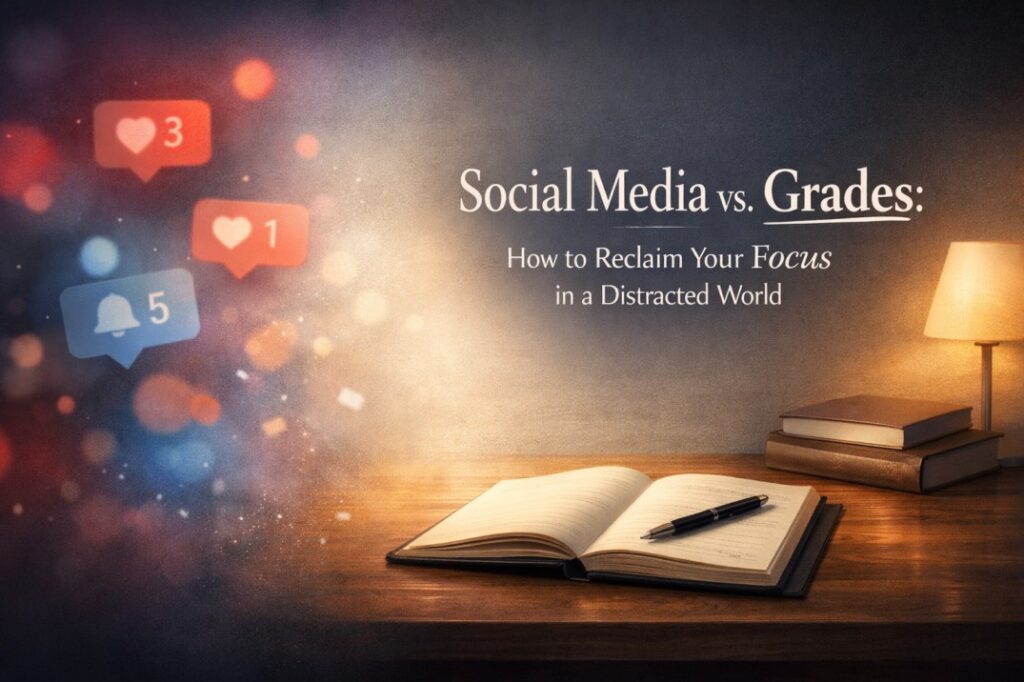
The tension of social media vs grades no longer feels dramatic, it feels routine, subtle, and quietly exhausting for students everywhere today. Most students open their phones for five minutes and lose thirty, then wonder why focus feels broken and confidence keeps slipping.
This confusion does not come from laziness or lack of ambition. It grows from a distracted environment that pulls attention in dozens of small directions while academic pressure keeps rising steadily.
This guide will help you understand what is really happening, without blame, and show how focus can return with clarity, structure, and emotional balance.
In this Guide:
Understanding the Social Media vs Grades Conflict
The struggle of social media vs grades does not appear suddenly. It builds slowly through habits that feel harmless, familiar, and socially accepted.
Students live in a world where notifications never pause. Study time now competes with reels, chats, updates, and comparison loops that quietly drain mental energy.
Focus feels harder not because students changed, but because attention gets divided repeatedly throughout the day.
Once this pattern becomes normal, distraction no longer feels like a problem. It feels like life.
Why Distraction Feels Normal Now
Phones stay within arm’s reach almost all day. Each vibration or screen light invites the brain to shift focus instantly.
Over time, the mind learns to expect interruption. Silence begins to feel uncomfortable instead of calming.
Students sit with books open, yet their attention keeps scanning for the next digital cue. This state feels normal because everyone around them lives the same way.
Normalization makes distraction invisible.
How Attention Gets Fragmented Daily
Focus rarely disappears in one moment. It breaks through dozens of micro interruptions.
Checking one message turns into checking five. One short video leads to ten.
Each switch forces the brain to restart concentration. Learning becomes shallow, and memory struggles to lock information.
Hours pass, effort increases, yet progress feels minimal. This fragmentation slowly weakens academic confidence.
The Real Academic Cost of Constant Scrolling
The cost of distraction extends beyond grades. It affects emotional stability, motivation, and self trust.
Students study longer but understand less. They revise repeatedly yet forget faster.
This pattern creates frustration, then guilt, then avoidance. Scrolling becomes a relief from stress, even though it causes it.
Understanding this cost brings awareness, not fear.
Declining Focus and Memory Retention
Learning requires uninterrupted mental presence. Constant switching prevents information from settling deeply.
Students may read the same paragraph multiple times. Concepts feel familiar but unclear during exams.
This leads to panic before tests. Confidence drops even when effort remains high.
Emotional Fatigue and Study Avoidance
Mental exhaustion builds quietly. Students feel tired before they even begin studying.
Books start triggering stress responses. Phones offer quick emotional escape.
Avoidance feels easier than facing incomplete understanding. This cycle repeats until academic pressure feels overwhelming.
Why Willpower Alone Does Not Work
Many students blame themselves for poor discipline. They promise strict control and fail repeatedly.
This happens because social media vs grades is not a willpower issue. It is a habit and environment issue.
Force creates resistance. Sustainable focus comes from redesigning systems, not fighting impulses.
The Myth of Self Control
Motivation fluctuates naturally. Expecting constant discipline ignores human psychology.
Even strong students struggle when distractions surround them constantly. Intentions collapse without supportive structure.
Understanding this removes shame. Change becomes possible when blame disappears.
Habit Loops and Dopamine Traps
Notifications deliver small rewards. The brain learns to crave them during boredom or stress.
This loop strengthens through repetition. Stopping suddenly feels uncomfortable, not empowering.
Breaking the loop requires awareness and gentle redirection, not force.
Rebuilding Focus Without Quitting Social Media
Quitting platforms completely often fails. It feels extreme and unsustainable.
The solution to social media vs grades lies in balance, not elimination. Students need boundaries that respect modern reality.
Focus rebuilds when technology supports life instead of controlling it.
Creating Digital Boundaries That Stick
Boundaries work best when they feel reasonable. Small rules outperform strict bans.
Placing the phone out of reach during study blocks helps. Turning off non essential notifications reduces mental noise.
Consistency matters more than perfection.
Designing a Distraction Aware Study Routine
Modern study routines must respect shorter attention spans. Long sessions often backfire.
Breaking study into focused blocks improves retention. Clear start and end points reduce mental fatigue.
This approach builds momentum gradually.
Emotional Triggers Behind Phone Dependency
Phones rarely distract without emotional reasons. Stress, pressure, and comparison fuel excessive use.
Students scroll to escape expectations. Validation becomes a substitute for self worth.
Understanding these triggers restores control.
Stress, Comparison, and Escape
Academic pressure keeps rising. Social feeds highlight success stories constantly.
Comparison erodes confidence quietly. Scrolling becomes emotional numbing rather than entertainment.
This pattern weakens motivation further.
Fear of Missing Out and Validation Cycles
Students fear disconnecting socially. Likes and replies feel emotionally significant.
Silence triggers anxiety. Presence online feels safer than presence with books.
Awareness breaks this cycle gently.
Read more on Healthify Happiness:
- Finding Your Why: A Spiritual Guide to Discovering Your Soul’s Purpose
- Why You Feel Stuck: Unlocking the Power of Subconscious Emotional Healing
- From Chaos to Calm: How to Build a Stress-Free Work Culture
- Heal the Mother Wound: Breaking Generational Patterns for a Freer Life
- Anxiety Before Exams? 5 Breathing Techniques to Calm Down in Minutes
Practical Focus Reset Techniques for Students
Focus returns through small, repeatable actions. Consistency matters more than intensity.
These tools help students regain clarity without pressure. They fit real student life.
Micro Focus Sessions
Short study sessions reduce resistance. Twenty focused minutes outperform distracted hours.
Clear goals guide each session. Breaks restore energy instead of draining it.
Momentum builds naturally.
Mindful Phone Usage Habits
Using phones consciously changes behavior. Asking why before opening apps increases awareness.
Planned scrolling feels satisfying. Mindless scrolling loses control.
This shift restores autonomy.
Success Story
Aarav from Jaipur struggled with falling grades despite long study hours. His phone stayed beside him during every session.
After learning focus boundaries, he redesigned his routine. He placed his phone outside the room and used short study blocks.
Within weeks, comprehension improved. Anxiety reduced and confidence returned.
His grades stabilized without quitting social media completely.
How Dr. Kaveri Bhatt Helps Students Reclaim Focus and Academic Confidence
The core struggle behind social media vs grades often lies beneath surface habits. Dr. Kaveri Bhatt addresses this at the subconscious level.
Her techno spiritual approach combines emotional regulation with practical focus tools. She works with trauma informed techniques that release stress stored in the nervous system.
When emotional overload reduces, attention stabilizes naturally. Students stop escaping into screens because internal pressure softens.
Her work helps students reconnect with clarity, calm, and self trust. Focus becomes a natural outcome, not a forced behavior.
User Reviews
Neha Sharma, Delhi
“I finally understood why studying felt exhausting. Small changes helped me regain focus without pressure or guilt.”
Rohan Mehta, Ahmedabad
“This approach felt realistic. I stopped blaming myself and built habits that actually worked.”
Simran Kaur, Ludhiana
“My attention improved gradually. I now trust my study routine instead of fighting it daily.”
Forum Discussions
Forum Question
“Can I improve grades without deleting all social apps?”
Student Reply
“Yes. Creating boundaries helped me focus while staying connected socially.”
Forum Question
“Why do I feel anxious when I keep my phone away?”
Student Reply
“It happens due to habit loops. Awareness reduces anxiety over time.”
Frequently Asked Questions
Does social media always harm academic performance?
Social media itself does not harm grades. Unstructured usage and emotional dependency create distraction that affects focus and learning quality.
How long does it take to rebuild focus?
Most students notice improvement within two to three weeks when they apply consistent focus boundaries and emotional awareness.
Should students quit social media during exams?
Temporary reduction helps, but balanced usage with clear boundaries works better long term than complete removal.
Why do students feel tired before studying?
Mental fatigue builds from constant attention switching, not from lack of sleep alone.
Can emotional stress affect concentration?
Yes. Stress activates survival responses that reduce cognitive clarity and learning efficiency.
Conclusion
The conflict of social media vs grades does not require extreme solutions. It requires understanding, structure, and emotional balance.
Focus is not lost forever. It waits beneath habits that can be redesigned gently.
Students regain confidence when they stop fighting themselves. Clarity grows when attention receives respect.
With awareness and practical steps, focus becomes reliable again.
Need personalized guidance?