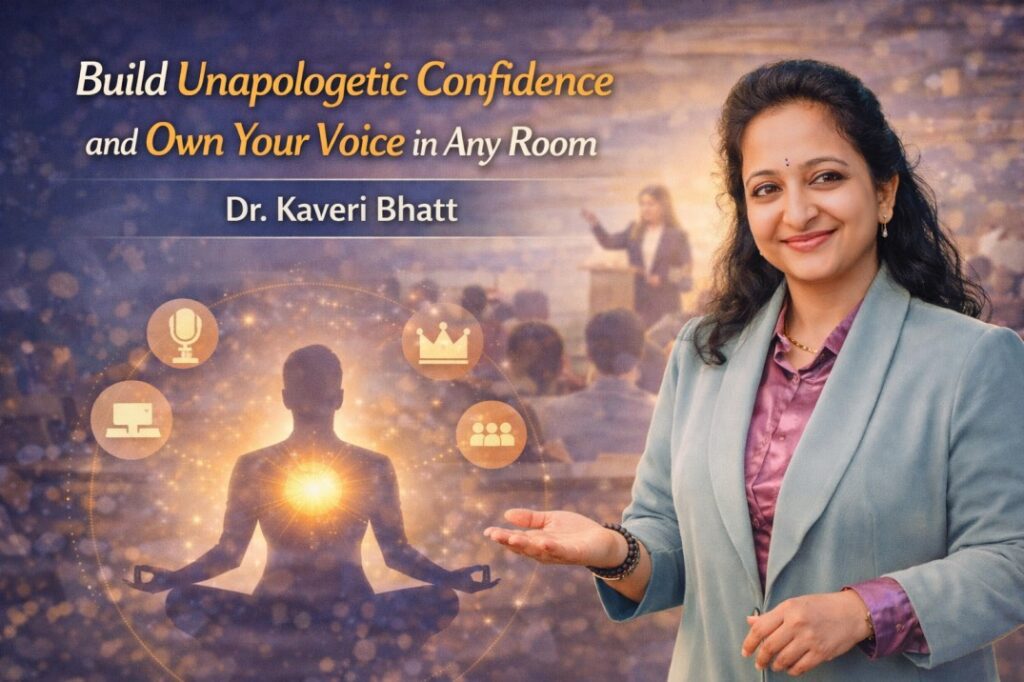
You do not suddenly wake up and Build Unapologetic Confidence. It does not arrive as a personality upgrade. Instead, it begins in the quiet decision to stop shrinking in spaces where you belong.
Many capable people hesitate before speaking. They rehearse sentences in their mind. They soften opinions so others feel comfortable. Over time, that habit creates distance from their own voice. Dr. Kaveri Bhatt often meets individuals who appear strong yet feel uncertain inside. They doubt whether their truth deserves space.
This inner conflict rarely starts in adulthood. It usually forms when emotional safety feels conditional. To Build Unapologetic Confidence, you must first understand why you learned to apologize for your presence. Awareness creates clarity. Clarity creates choice.
In this Guide:
Why We Shrink Ourselves Without Realizing
Shrinking rarely looks dramatic. It hides in polite smiles, lowered tones, and delayed responses. This pattern does not mean you lack strength. Instead, it reflects adaptation. At some point, you learned that harmony mattered more than honesty.
Over time, the body memorizes that lesson. Your nervous system reacts before your logic does. Therefore, even small disagreements can feel risky. Dr. Kaveri Bhatt explains that many adults confuse conditioning with personality. They say, “I am just not confident.” In reality, they learned that staying small protected relationships.
Childhood Conditioning and Silent Adaptation
Childhood environments shape emotional responses deeply. If you grew up where disagreement led to criticism, silence felt safer. These adaptations were intelligent at the time. However, what once protected you may now restrict you. When you view your past through this lens, guilt softens.
The Emotional Roots of Self Doubt
Self doubt rarely appears without history. It forms when experiences repeatedly question your reality. Subtle dismissal can impact confidence as much as visible criticism. If your feelings were minimized, you may now minimize them yourself.
The subconscious stores these moments. Although your conscious mind forgets details, your body remembers emotional impact. Therefore, situations that resemble past dynamics trigger hesitation.
The Nervous System and Confidence
Confidence is not only psychological. It is physiological. When the body feels regulated, speech becomes steady. However, chronic stress disrupts this regulation. Dr. Kaveri Bhatt works gently with nervous system awareness. She helps individuals identify bodily sensations linked to self doubt. Through grounding practices, clients learn to stabilize internally.
What Real Confidence Actually Feels Like
Real confidence feels steady. It does not shout. It does not seek applause. Instead, it rests in alignment between thought and expression. Performance based confidence depends on validation. Grounded confidence remains stable even without praise.
To Build Unapologetic Confidence, you must redefine it. It is not dominance. It is clarity. It is not control. It is self respect.
Calm Authority in Everyday Moments
Calm authority shows in simple interactions. You request clarification without apology. You state preferences without guilt. These behaviors may seem small. However, they reflect inner stability. Over time, repeated small choices reinforce self trust.
How Dr. Kaveri Bhatt Helps You Build Unapologetic Confidence
Dr. Kaveri Bhatt integrates a techno spiritual healing approach with trauma informed understanding. Her background in engineering and decades in the IT sector shaped her analytical clarity. Meanwhile, her certifications in NLP, hypnotherapy, EFT, inner child healing, and energy work deepen her emotional insight.
She does not offer surface level motivation. Instead, she addresses subconscious patterns that restrict expression. Through guided sessions, clients explore stored emotional memories safely. Additionally, she provides practical emotional tools for real world integration.
Clients practice boundary setting and grounding exercises that translate into daily life. This combination of analytical clarity and holistic healing allows you to Build Unapologetic Confidence sustainably.
Success Story: Finding a Voice in the Boardroom
Riya, a marketing professional from Delhi, struggled to speak in team meetings. Although she prepared thoroughly, her voice often trembled. She needed to Build Unapologetic Confidence to advance her career.
After sessions with Dr. Bhatt, she explored childhood memories linked to criticism. Through subconscious release work and grounding practices, Riya noticed her body relaxing during conversations. She practiced expressing small opinions first. Gradually, she asserted larger ideas. Within months, colleagues recognized her clarity.
Real Experiences
Ananya from Mumbai: “Learned to observe triggers calmly. Now communicates boundaries without guilt.”
Rahul from Bengaluru: “Through nervous system regulation, speaks with clarity and presence in leadership roles.”
Megha from Pune: “Subconscious belief work helped release fear of judgment. Feels lighter and more authentic.”
Community Conversations
Question: Can confidence develop later in life?
Answer: Yes. The nervous system can learn safety at any stage when supported consistently.
Question: Will healing reopen pain?
Answer: No. Trauma informed processes focus on regulation first, ensuring stability.
Frequently Asked Questions
Does confidence require personality change?
No. Confidence strengthens authenticity rather than altering identity.
How long does it take to build confidence?
Timelines vary. Small shifts often appear within weeks of consistent inner work.
Do subconscious techniques feel intense?
Sessions remain regulated and safe. Pacing matches readiness.
What about relapse?
Occasional setbacks occur. Awareness helps you return to alignment quickly.
Does success create confidence?
Achievement increases visibility, but emotional safety sustains true assurance.
Conclusion
To Build Unapologetic Confidence is not to become louder. It is to become aligned. It is to feel steady even when others disagree.
Confidence grows when emotional safety replaces fear based adaptation. Through awareness, subconscious healing, and practical integration, self trust becomes natural. Dr. Kaveri Bhatt’s work reminds us that hesitation carries history. When you honor that history gently, you release its grip.
Need personalized guidance?